Clothes Donation Bin: What Happens to Your Clothes After You Drop Them Off?
You have a bag of clothes.
You do not wear them anymore. Throwing them in the rubbish feels wrong, but selling every shirt, pair of jeans, or old jacket takes time.
That is where a clothes donation bin can help.
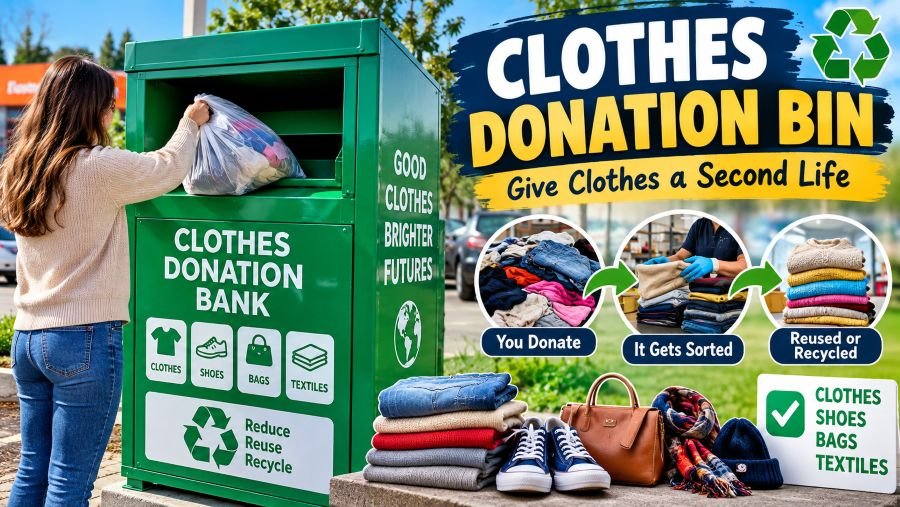
These large collection containers, often called clothing bank bins, clothes banks, textile banks, or charity clothing banks, give people a quick way to pass on unwanted clothing and textiles.
But what happens after the door shuts?
Actually, the answer varies. Some clothes reach charity shops. Some enter other second-hand markets. Lower-grade textiles may go for recycling. The exact route depends on the organisation running the bank and the condition of your donation.
Quick Facts
| Quick Fact | Details |
|---|---|
| Main purpose | Collect unwanted clothing and textiles for reuse or recycling |
| Common UK names | Clothes bank, clothing bank, textile bank, charity clothing bank |
| Common locations | Supermarkets, car parks, recycling points and community sites |
| Good clothes accepted? | Usually yes |
| Shoes accepted? | Often, normally as pairs |
| Accessories accepted? | Many operators accept selected bags, belts, hats and scarves |
| Damaged clothes accepted? | Depends on the individual collection |
| Wet or dirty clothes? | Usually unsuitable |
| Are donations always given away free? | No |
| Can clothes be sold? | Yes |
| Can textiles be recycled? | Yes, where suitable recycling routes exist |
| Can commercial firms run charity banks? | Yes, under arrangements with charitable organisations |
| Should you leave bags beside a full bank? | No |
What Is a Clothes Donation Bin?
A clothes donation bin is a collection container made for unwanted clothing and, in some cases, other textiles.
The idea is simple.
You bring suitable items. You place them inside. The operator collects them later.
These containers are normally built with a restricted opening and locked access because clothing inside may have resale value.
In the UK, you may see several names printed on them:
- Clothing bank
- Clothes bank
- Textile bank
- Charity clothing bank
- Clothes recycling bin
- Textile recycling bank
- Donation bank
The wording can change, but never assume every bin accepts the same things.
Check the label first.
Recycle Now says clothes and textiles can be taken to some out-of-home recycling points, including clothing and textile banks found in places such as supermarket and local car parks. Retailers may also run in-store clothing return schemes.
What Can You Put in Clothing Bank Bins?
Rules depend on the operator.
A charity collecting clothes for resale may want clean, wearable items. A textile collection system may accept a wider range.
Commonly accepted items can include:
- T-shirts
- Shirts
- Jumpers
- Jeans
- Trousers
- Dresses
- Skirts
- Coats
- Jackets
- Children’s clothes
- Paired shoes
- Handbags
- Belts
- Hats
- Scarves
- Gloves
- Some household textiles
Oxfam, for example, accepts good-condition clean clothing, children’s clothes, vintage clothing, paired shoes, bags, belts, hats, scarves and gloves through its donation system.
Simple rule?
Read the instructions.
A clothing bank is not a general rubbish bin.
Should Clothes Be Clean Before Donation?
Yes, where possible.
Clean clothes are much easier to sort, sell and pass on.
Oxfam asks donors to wash clothing unless the item is new.
Dry matters too.
Wet clothing can smell. It can develop mould. Worse, moisture may damage other good donations sitting inside the same bank.
So check your bag.
Clean. Dry. Ready.
That gives the clothing a better chance of staying in use.
Should You Put Clothes in a Bag?
Check the collection instructions.
Some textile banks ask donors to place clothes inside smaller bags. That helps keep items together and makes handling easier.
Do not force a huge sack through a small opening.
Ealing Council advises people using its clothing banks to put donations inside the bank and notes that large black sacks may not fit, so smaller bags can work better.
Shoes are another easy fix.
Keep pairs together.
Nobody wants one trainer arriving at one end of a sorting centre while its partner disappears somewhere else.
What Should You Not Put in a Clothes Donation Bin?
Again, the label wins.
Still, there are some obvious items you should keep out unless the operator clearly says they are accepted.
These may include:
- General household rubbish
- Food waste
- Wet clothing
- Mouldy clothing
- Heavily contaminated fabric
- Paint-covered textiles
- Electrical items
- Furniture
- Mattresses
- Carpets
- Loose rubbish
- Unaccepted bedding
- Unaccepted work uniforms
Some local textile banks have their own strict lists.
For example, Portsmouth City Council says its textile banks accept items including clothes, paired shoes, handbags, belts, gloves, scarves, bed linen, towels and soft toys, but exclude several items such as soiled clothing, duvets, pillows, cushions and some workwear.
That does not mean every UK bank follows Portsmouth’s list.
Rules change by collection.
Check yours.
What Happens to Clothes After Donation?
Here is how it usually works.
The bank fills up.
A collection team empties it.
The clothing then moves into a sorting system.
Workers or specialist textile sorters separate items based on condition, type, resale value and possible next use.
Good clothes may have several routes.
They might be:
- Sold through charity shops
- Sold online
- Sent to another shop
- Sold through second-hand textile markets
- Passed to specialist textile traders
- Sent for material recycling if reuse is not practical
Oxfam says clothing that can be sold may go through its shops or online channels. Lower-grade material that cannot be sold as normal clothing may pass through textile recycling routes, where some materials can become products such as mattress filling or car soundproofing.
So yes, your old jumper may take a very different path from your old jeans.
Are Donated Clothes Given Directly to People in Need?
Not always.
This confuses many donors.
A charity clothing bank does not necessarily work like a direct clothes handout.
A charity may sell donated clothes and use the money raised to fund its work.
That means the physical jacket you donate might be bought by a customer rather than given away free.
Both models exist.
The bank label and the organisation’s website should explain how the collection works.
This matters because donors should know where their items are going and who benefits from them.
Can Donated Clothes Be Exported?
Yes.
Part of the UK’s second-hand clothing supply enters overseas resale markets.
WRAP wrote in 2024 that around 60% of second-hand clothing was being exported to overseas second-hand markets.
That does not mean every exported garment is waste.
Reusable second-hand clothing has active markets in many countries.
Quality matters, though.
Poor-quality material that cannot realistically be reused creates problems for collectors, sorters and receiving markets. This is one reason good sorting matters before textiles are sold or exported.
What Happens to Clothes That Cannot Be Worn Again?
Some can be recycled.
Not every garment can become another garment, though.
Fabric type, fibre mix, contamination, coatings, buttons, zips and available recycling systems can all affect what happens next.
Recycle Now says textiles that cannot be passed on for reuse may sometimes become items such as cleaning cloths, padding for car seats or chairs, and industrial blankets.
There is another issue.
Low-grade textiles have become harder to handle financially.
WRAP’s 2024 market report found that the price paid per tonne for textile-bank donations had fallen 57.5% between 2013 and 2023 before inflation was taken into account. The reported 2023 figure was £172.50 per tonne for textile-bank donations.
Basically, collecting unwanted textiles costs money too.
Can You Put Torn Clothes in Clothing Bank Bins?
Maybe.
Check first.
Some textile recycling collections can take worn or damaged fabric.
Other charity banks want reusable clothing only.
Do not think:
“It is fabric, so it belongs in there.”
That can create more sorting work and may leave the collector paying to dispose of material it cannot use.
Look for words such as:
Reusable clothing
Wearable clothes only
Textiles for recycling
Clean textiles
Those labels give you a much better clue.
Why Clothing Banks Matter
Britain throws away a huge amount of clothing and household textiles.
WRAP’s 2024 Textiles Market Situation Report, using 2021 disposal data, estimated that about 711,000 tonnes of used textiles were discarded through household rubbish and general-waste containers at household waste recycling centres.
That represented about 49% of used textiles, or roughly 35 items per person per year.
That is a lot of fabric.
Much of it still has possible reuse or recycling value.
Recycle Now also reports that around 49% of unwanted UK textiles are put into rubbish each year and encourages people to use reuse and textile collection routes where suitable.
A nearby clothing bank makes that choice easier.
No listing photos.
No buyer messages.
No parcel shipping.
Drop it off. Done.
Where Can You Find Clothing Bank Bins?
Common locations include:
- Supermarket car parks
- Local recycling points
- Household recycling centres
- Charity sites
- Community locations
- Retail parks
- Selected council sites
- Some schools or organisations
Locations change.
So do operators.
Recycle Now provides a recycling-point search for clothing and textiles, while many councils and charities publish their own local bank locations.
Searching “clothing bank near me” or checking your council’s recycling page is usually a good start.
What If the Clothing Bank Is Full?
Take your bag home.
Do not leave it beside the bin.
This part really matters.
Ealing Council states that leaving bags next to a clothing bank is fly-tipping and can also expose donations to rain and dirt.
Colchester City Council gives similar advice: if a bank is full, bags should not be left beside it because doing so can count as fly-tipping.
North Ayrshire Council issued another warning in July 2026 after donations were left outside full charity banks. The council said exposed bags can become wet, dirty or opened, leaving items unsuitable for reuse or recycling.
Good intentions do not change that.
Try another bank.
Or come back later.
How Can You Check Whether a Clothing Bank Is Genuine?
Look at the information printed on it.
A proper charity collection should not leave you guessing.
The UK Code of Fundraising Practice treats clothing and goods donation banks as unstaffed collections. The current code took effect on 1 November 2025.
For these collections, donors should be able to see clear and current information about the charitable organisation receiving the donation, including registration information and contact details.
Where a third-party collector runs the collection, information should also cover the collector and how fundraising partners are paid. Processing fees and any secondary purpose for donations should be easy for donors to find.
Before dropping anything in, check for:
- Charity or organisation name
- Charity or company registration details
- Contact information
- Collector details where relevant
- Accepted items
- Information about how donations are handled
- A website or short link for more details
Something looks odd?
Check before donating.
Can Commercial Companies Run Charity Clothing Banks?
Yes.
A clothing bank carrying a charity’s name may be serviced by another organisation.
The collector might handle pickup, sorting or textile sales under an agreement with the charity.
Current fundraising rules require clearer information where third-party collectors are involved.
The Textile Recycling Association’s code of conduct also says member clothing-bank operators should clearly mark their banks with information such as service contact details, the beneficiary and the materials accepted. Its members should also have written permission from the landowner or site manager for bank locations.
Transparency matters here.
You should know who you are giving to.
Can Anyone Put a Clothing Bank on a Car Park?
No.
A collection operator needs permission for the location.
Under the current Fundraising Code, static collection and clothing-bank operators must have a written agreement with the site manager or owner. That agreement should cover responsibilities, collection arrangements, ending the arrangement, theft and damage reporting.
The Textile Recycling Association sets a similar requirement for members operating clothing and textile collection banks.
So a charity bank should not simply appear on private land without an agreement.
Do Clothes Donation Bins Make Money?
They can.
Reusable clothes have financial value.
A charity may sell clothing itself. A trading arm may handle it. A textile business may collect and sort it under an agreement.
Money raised can then support the named charity or organisation according to the collection arrangement.
Still, collection is not free.
Transport costs money.
Sorting costs money.
Storage costs money.
Poor-quality textiles can cost money to process.
That is why the information printed on a charity bank matters.
Can Gift Aid Apply to Donated Clothes?
Not directly to the physical clothes.
HMRC states that Gift Aid applies to gifts of money, not simply to donated physical goods such as clothes or books.
Charity shops can run a Retail Gift Aid system.
Under such a system, the charity or its trading company can act as the owner’s agent to sell the goods. The donor can then agree to give qualifying sale proceeds to the charity, and Gift Aid may apply to the eligible monetary donation if the rules are met.
So donating a jumper does not automatically create Gift Aid.
The sales arrangement matters.
Clothes Donation Bin vs Charity Shop
Both have a place.
A clothing bank is quick.
A charity shop gives staff a chance to see the item directly.
For ordinary wearable clothes, either may work.
For something expensive, collectible, designer or unusual, taking it into a charity shop may make sense because staff can assess it before it enters bulk textile sorting.
A donation bin works well for convenience.
The main point stays the same.
Use the right route.
Clothes Donation Bin vs Selling Online
Got valuable clothing?
Selling may be worth the work.
You can list good items on resale apps or marketplaces, take photos, answer buyers and post parcels.
That takes time.
Donation is easier.
Some people do both.
Sell the stronger pieces. Donate the rest.
Simple.
How to Prepare Clothes for a Donation Bank
You do not need a complicated routine.
Start with the clothes you no longer want.
Check each item.
Ask yourself:
Would someone reasonably wear this again?
Then:
- Check the instructions on your chosen bank.
- Wash reusable clothing where appropriate.
- Make sure everything is dry.
- Keep shoes in pairs.
- Remove personal items from pockets.
- Pack items in suitable bags if requested.
- Put donations fully inside the bank.
- Take them elsewhere if the bank is full.
That is pretty much it.
Check Pockets Before Donating
Easy to forget.
Check every pocket.
People leave keys, receipts, coins, bank cards, earphones and personal papers inside jackets and trousers all the time.
Once clothing enters a collection system, getting the item back may be very difficult.
So spend one minute checking.
Worth it.
Is a Clothing Bank the Same as a Recycling Bin?
Not always.
This difference matters.
A charity clothing bank may mainly collect reusable garments for resale.
A textile recycling bank may accept material that can no longer be worn.
Some systems do both.
The name alone does not tell you enough.
Read the accepted-item list.
What Is the Best Choice for Good Clothing?
Keep useful clothes in use.
That might mean:
- Wearing them longer
- Repairing them
- Giving them to friends or family
- Selling them
- Donating them
- Using an approved clothing bank
For clothes that truly cannot be reused, check whether your council or local textile scheme offers a suitable recycling route.
Recycle Now recommends selling or donating clothes that remain in good condition and checking local recycling options for other textiles.
Common Mistakes to Avoid
A few small mistakes cause big problems.
Leaving bags outside
Do not.
A full bank means find another collection point.
Donating wet clothes
Dry them first.
Treating every bank as a textile recycler
Some only want wearable items.
Sending single shoes
Keep the pair together.
Ignoring the label
Rules vary between operators.
Using an unidentified collection bin
Check who operates it and who benefits.
Treating it like general waste
Never dump rubbish inside.
FAQs
1. What is a clothes donation bin?
It is a collection container used for unwanted clothing and, depending on the operator, other textiles. Clothes may later be reused, sold or sent through suitable recycling routes.
2. What are clothing bank bins used for?
They collect unwanted clothing away from normal household rubbish. The collected items can then enter reuse, resale or textile-processing systems.
3. Can I put old clothes in a clothing bank?
Usually yes if the clothes meet the bank’s rules. Some banks want reusable clothing only, while others accept certain worn textiles.
4. Can I put damaged clothes in a clothes donation bin?
Only if the operator accepts them. Check the wording on the bank before depositing torn or badly worn textiles.
5. Do clothes need washing before donation?
Clean clothing is preferred. Oxfam specifically asks donors to wash clothes unless they are new.
6. Can shoes go into clothing bank bins?
Many clothing collections accept shoes, but they should normally be donated as matching pairs. Oxfam lists paired shoes among accepted donations.
7. What happens if a clothes bank is full?
Do not leave bags next to it. Take your donation home or use another approved collection point. Councils warn that bags left outside can count as fly-tipping.
8. Are donated clothes always given away for free?
No. Many charities sell donated clothing to raise money. Some textiles may also go through wholesale second-hand or recycling routes.
9. Can clothes from UK donation bins go abroad?
Yes. Some reusable second-hand clothing enters overseas markets. WRAP reported in 2024 that a large share of second-hand clothing was exported.
10. How do I know if a charity clothing bank is real?
Look for the charity or organisation name, registration information, contact details and collector details where relevant. Current UK fundraising standards require clear information for unstaffed charity collections.
Final Thought
A clothes donation bin looks simple.
Drop clothes in. Walk away.
But there is a full reuse and sorting system behind that little metal door.
Good clothing may find another owner. Some textiles may become raw material for another use. Charity collections can also raise money for their work.
Your part is easy.
Donate clean items. Check the bank’s rules. Keep rubbish out. Never leave bags beside a full container.
That one small decision gives unwanted clothes a much better chance of staying out of general waste.