What Is Upcycled Fashion? How Old Clothes Get a New Life
Introduction
Fashion creates a lot of waste.
Yet plenty of that fabric can still be used.
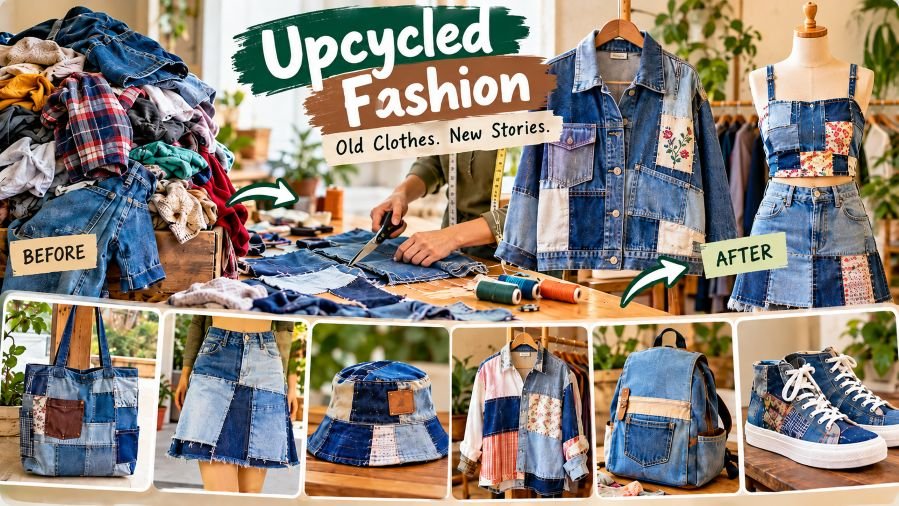
That simple idea sits behind upcycled fashion. Old jeans may become a patchwork jacket. Two unwanted shirts can become one new top. Fabric scraps may turn into a handbag, skirt, or completely different garment.
The material gets another life.
And often, another look.
Quick Facts About Upcycled Fashion
| Quick Fact | Details |
|---|---|
| Main idea | Existing textiles are changed into new products |
| Common materials | Old clothes, denim, fabric scraps, deadstock and damaged garments |
| Typical products | Jackets, tops, skirts, bags, hats and accessories |
| Is it recycling? | No. Recycling usually breaks material down before making something new |
| Is thrifted clothing upcycled? | No, unless the garment is changed into a new design |
| Main benefit | Keeps usable material in circulation |
| Common style | Patchwork, reconstructed garments and mixed fabrics |
| Main challenge | Sorting and rebuilding garments takes time and skilled work |
What Is Upcycled Fashion?
Upcycled fashion is the practice of changing discarded or unwanted clothing and textiles into new fashion products.
The original material usually stays recognisable.
Textile Exchange describes upcycling as modifying discarded products so they become new quality items, such as apparel or accessories, which can enter the textile supply chain again.
That definition matters.
Think about an old pair of jeans.
Selling those jeans to another person is reuse.
Repairing a ripped knee is repair.
Shredding the jeans into fibre and making new yarn is recycling.
Cutting those jeans apart and turning the denim into a bag or jacket is upcycling.
Pretty clear once separated.
How Does Upcycled Fashion Work?
There is no single method.
Each maker works differently.
Still, the process often starts with clothing or fabric that is no longer wanted in its existing form.
The designer first checks it.
Good sections are kept.
Weak sections may be removed.
The garment can then be cut apart, reshaped, combined with other pieces, dyed, stitched, patched, embroidered, or rebuilt.
A pair of trousers might become a skirt.
Three shirts may form one dress.
Several denim washes can be joined into a new jacket.
Basically, the designer works with what already exists instead of starting with a fresh roll of fabric.
That can make the design process less predictable.
It also makes it interesting.
What Materials Can Be Upcycled?
Almost any usable textile may work.
Some are easier than others.
Common materials include:
- Old jeans
- Shirts
- T-shirts
- Dresses
- Jackets
- Workwear
- Uniforms
- Vintage clothing
- Fabric offcuts
- Factory scraps
- Sample garments
- Surplus textiles
- Damaged clothing
- Deadstock fabric
- Curtains and household textiles
Denim is especially popular.
It is usually tough.
Large usable panels can often be cut from old jeans, and details such as pockets, seams, waistbands and faded areas can become part of a new design.
What Is Deadstock Fabric?
Deadstock generally refers to unused fabric or stock left from earlier production.
That could come from over-ordering, cancelled production, previous collections, sampling, or material a company no longer plans to use.
Using deadstock does not automatically make an item upcycled.
There needs to be some form of new use or redesign.
For example, making a new jacket from unused surplus fabric can fit within wider waste-reduction fashion practices.
Taking finished unwanted garments apart and rebuilding them is a clearer example of garment upcycling.
Examples of Upcycled Fashion
Upcycling can be very simple.
Or quite complex.
Here are common examples:
Old Jeans Into a Jacket
Several pairs of jeans can be cut into panels.
Those panels are joined together.
Now the denim has a completely different form.
Shirts Into a Dress
Designers sometimes combine several unwanted shirts.
Sleeves, collars, pockets and body panels can be rearranged into one garment.
T-Shirts Into Tops
Large or damaged T-shirts can be cut and resewn into fitted tops, cropped pieces, skirts, or mixed-panel clothing.
Clothing Into Bags
Jeans, coats, uniforms and heavy shirts can work well for tote bags, shoulder bags and small accessories.
Fabric Scraps Into Patchwork
Small fabric pieces may still be useful.
A maker can join them together to form a larger textile panel.
That panel can then become clothing.
Damaged Clothing Into New Designs
A stain does not always kill a garment.
Neither does one torn section.
The damaged area can sometimes be removed, covered, replaced, embroidered, or worked into a new design.
Upcycled Fashion vs Recycled Fashion
These two terms get mixed up.
They mean different things.
Upcycling
The existing material is usually kept largely intact.
It gets cut, changed, combined, or rebuilt.
Example:
Old jeans → new denim handbag
Recycling
The material usually goes through another processing stage.
Textiles may be shredded, separated, dissolved, or turned back into fibre before being used again.
Example:
Old cotton clothing → recycled cotton fibre → new yarn → new fabric
The distinction is useful.
One keeps much of the existing material structure.
The other creates a new material input.
Upcycled Fashion vs Second-Hand Fashion
Second-hand clothing already had another owner.
But it may remain completely unchanged.
Someone buying a used coat from a charity shop is taking part in clothing reuse.
The coat is not necessarily upcycled.
Now imagine that coat being cut into panels, shortened, fitted with fabric from another garment and rebuilt as a new piece.
That is much closer to upcycling.
Is Vintage Clothing Upcycled?
No.
Not automatically.
Vintage refers mainly to the age or period of an item.
Upcycling describes what happens to the material.
A vintage dress sold in its original condition remains vintage clothing.
A vintage dress that gets reconstructed into a different garment may be both vintage and upcycled.
Is Clothing Repair the Same Thing?
Usually not.
Repair aims to keep the original product working.
You fix the zip.
Sew the torn seam.
Patch a hole.
Replace a missing button.
The garment stays mostly the same.
Upcycling tends to involve a bigger design change.
Still, the line is sometimes fuzzy.
A heavily repaired garment with new panels, pockets and structural changes may begin looking more like an upcycling project.
Why Is Upcycled Fashion Popular?
Several reasons.
Waste is one.
Style is another.
People also like owning clothing that feels different from mass-produced pieces.
Two upcycled jackets may use the same basic pattern yet look completely different because the original materials have different colours, fades, stitching and wear marks.
That creates natural variation.
No fake effect needed.
There is also growing concern about textile waste.
UNEP says the textile industry produces around 2% to 8% of global greenhouse gas emissions and uses water equal to about 86 million Olympic-sized swimming pools each year.
So keeping useful textile material in use has become a bigger part of fashion discussions.
Why Textile Waste Matters
A huge quantity of clothing is still discarded.
The European Commission reports that about 5 million tonnes of clothing are discarded each year in the EU, equal to roughly 12 kg per person. It also states that only around 1% of material used in clothing is recycled into new clothing.
That leaves a big material problem.
Fabric can take energy, water, labour and raw materials to produce.
Throwing usable textile away means losing that work too.
Upcycling tries to keep some of that material useful for longer.
Main Benefits of Upcycled Fashion
It Keeps Existing Material in Use
This is the obvious one.
Instead of immediately throwing material away, someone finds another purpose for it.
It Can Reduce Textile Waste
One jacket will not fix the global waste problem.
Still, every usable garment kept away from disposal stays in circulation longer.
It Can Reduce the Need for New Fabric
An upcycled garment may replace part of the new textile material that would otherwise have been needed.
The exact saving depends on the product.
It Creates Distinctive Clothing
Used materials rarely look identical.
Different washes, prints, scratches and fades give each piece its own character.
It Supports Sewing Skills
Upcycling may involve cutting, pattern work, fitting, stitching and repair.
These are hands-on skills.
Good work takes practice.
It Can Give Damaged Clothing Another Use
A garment may no longer work in its original form.
That does not mean every part of it is useless.
A damaged pair of jeans can still contain large areas of strong denim.
Is Upcycled Fashion Always Sustainable?
No.
That claim would be too simple.
An upcycled product still has an environmental footprint.
It may need washing.
It may need dye.
New zips, buttons, thread or fabric might be added.
There can also be packaging and transport.
Quality matters too.
If badly made clothing falls apart after several wears, keeping old fabric out of waste for a short period offers limited value.
So the word upcycled tells us something about the source material.
It does not tell us everything about the product.
Upcycling and Circular Fashion
Upcycling sits within the wider idea of circular fashion.
Circular fashion aims to keep clothing and textile materials useful for longer instead of following a simple buy-wear-bin pattern.
The European Commission’s textile strategy supports longer-lasting, repairable and recyclable textiles, along with wider reuse and repair services.
Circular fashion can include:
- Wearing clothes longer
- Repairing garments
- Buying second-hand
- Reselling clothing
- Renting clothing
- Remaking garments
- Upcycling
- Textile collection
- Fibre recycling
No single method handles every problem.
Some clothes should simply keep being worn.
Others may be repaired.
Some work better for resale.
Damaged textiles may be good candidates for remaking or recycling.
Why Is Upcycled Clothing Sometimes Expensive?
This surprises people.
Old material sounds cheap.
The work may not be.
A maker may need to find suitable clothing, check every piece, wash it, sort it, take it apart, create a pattern, cut around damaged sections and sew everything back together.
Mass production works differently.
Factories can cut hundreds of identical panels from large fabric rolls.
Upcycling often starts with irregular pieces.
Each one needs checking.
That takes time.
Skilled labour can become a large part of the price.
Why Upcycling Is Hard to Scale
Consistency becomes tricky.
Imagine a designer needs 1,000 identical blue denim jackets.
Traditional production can order a large quantity of matching denim.
An upcycling business may have 500 different pairs of jeans.
Some are dark.
Some faded.
Some thin.
Some thick.
Some damaged.
Sizes differ too.
The designer has to work around those differences.
This is one reason upcycled clothing often appears in small batches or one-off pieces rather than massive identical collections.
Can Upcycled Fashion Be Mass-Produced?
It can be produced at larger volumes, but the material supply needs careful planning.
Factory offcuts can make this easier because the business may know exactly what fabric will remain after production.
Used consumer clothing is harder.
Condition varies.
Colour varies.
Fabric composition varies.
Some pieces are easy to reuse.
Others are not.
So industrial upcycling needs good sorting, storage, design planning and production systems.
How to Check If Clothing Is Really Upcycled
Do not judge from patchwork alone.
New fabric can look old.
Instead, check what the seller actually says.
Useful questions include:
What was the original material?
A good product description may explain whether the piece came from old jeans, surplus fabric, uniforms, production scraps, or another source.
How much reused material is present?
A tiny reused detail does not mean the whole garment was made from existing clothing.
Was the material actually changed?
Simple resale is different from upcycling.
Are new materials added?
That is not automatically bad.
But clear information helps buyers understand the product.
Does the seller explain the process?
Specific details are usually more useful than broad claims such as “green” or “eco-friendly.”
Simple Upcycled Fashion Ideas at Home
You do not need to create a designer coat.
Start small.
Turn Jeans Into Shorts
Old jeans can become summer shorts with simple cutting and finishing.
Add Patches to Damaged Denim
Use spare fabric to cover worn knees or holes.
Change an Oversized Shirt
A large shirt can become a fitted shirt, crop top, sleeveless piece, or dress depending on its size.
Make a Tote Bag
Heavy shirts and denim work well.
Old pockets can stay in place.
That saves work too.
Cover Permanent Stains
Embroidery, fabric panels or appliqué can hide marks that washing cannot remove.
Combine Two Garments
One shirt may provide the sleeves.
Another provides the main body.
Now the pieces have another use.
Upcycling vs Downcycling
These terms point in different directions.
Upcycling aims to make something with equal or greater practical, creative or commercial value.
Downcycling usually turns material into a lower-value use.
For example, badly damaged textiles might become cleaning cloths or low-grade filling material.
Both can keep waste away from disposal for a period.
But the value of the material changes differently.
Can Accessories Be Upcycled?
Yes.
Fashion includes much more than clothing.
Old textile material can become:
- Tote bags
- Handbags
- Wallets
- Hats
- Belts
- Scarves
- Hair accessories
- Jewellery
- Pouches
Heavy fabrics often work particularly well for bags.
Denim is a common choice.
Is Patchwork Always Upcycled?
No.
This is another common mistake.
Patchwork describes a construction method.
A brand could cut ten pieces of completely new fabric and stitch them together.
That is patchwork.
But it is not automatically upcycled.
If those pieces came from unwanted garments or existing textile waste, then the finished product may qualify as upcycled.
Is Upcycling Better Than Buying New Clothes?
There is no simple answer for every purchase.
Keeping a good garment you already own is often the simplest option.
No new product needed.
If clothing is genuinely unwanted or damaged, upcycling can help keep useful material working longer.
Buying an upcycled item purely to replace another perfectly usable garment still creates consumption.
Context matters.
Basically, longer use counts.
What Is the Future of Upcycled Fashion?
Interest in circular textile systems is growing.
Regulators are also putting more attention on garment durability, repair, reuse and recycling.
The European Commission’s 2030 textile vision calls for products placed on the EU market to become more durable, repairable and recyclable, while reuse and repair services become more widely available.
Upcycling can fit into that system.
But it will probably work beside repair, resale and recycling rather than replace them.
Some material is perfect for reconstruction.
Some is better reused unchanged.
Some needs fibre recycling.
The smart choice depends on the condition of the textile.
Frequently Asked Questions
What is upcycled fashion in simple words?
Upcycled fashion means taking existing clothing or textile material and changing it into a new fashion product instead of throwing the material away.
What is an example of upcycled clothing?
A jacket made by cutting apart several unwanted pairs of jeans is a simple example.
Is upcycling the same as recycling clothes?
No. Upcycling normally keeps much of the existing fabric intact. Textile recycling often processes clothing back into fibres or another material input.
Is second-hand clothing upcycled?
Not by itself. Second-hand clothing becomes upcycled when it is substantially changed or rebuilt into another product.
Are vintage clothes upcycled?
Vintage clothing is not automatically upcycled. A vintage item can become upcycled if it is redesigned or reconstructed.
Why is upcycled fashion expensive?
Sorting, cleaning, cutting and rebuilding irregular garments can require a lot of skilled manual work. Small production runs can also cost more per item.
Can I upcycle clothes myself?
Yes. Simple projects include shortening jeans, adding patches, changing oversized shirts, covering stains, making tote bags and combining parts from different garments.
Is upcycled fashion good for the environment?
It can help keep usable textiles in circulation and may reduce demand for some new material. But its actual impact depends on production, transport, added materials, durability and how long the finished item is used.
Final Thought
Upcycled fashion gives existing material another chance.
That is the main idea.
Old jeans do not have to stay jeans. A damaged shirt does not always belong in the bin. Fabric scraps can still carry real value when someone has the skill and time to work with them.
Still, upcycling is one piece of a bigger clothing system.
Wear what you own.
Repair what still works.
Resell useful pieces.
Then remake materials that need a new purpose.
Simple choices can keep clothes moving for longer.